
Ridge and hip capping sits on a bed of mortar, finished with pointing. As the bedding breaks down, caps loosen and wind-driven rain gets in under them. Royce Roofing strips the old mortar, rebeds the caps and finishes them with flexible pointing that moves with the roof. Done properly, a rebed and repoint should last 15 to 20 years.
At a glance
- Failed ridge bedding is one of the most common causes of tiled roof leaks
- We remove the old mortar, rebed the caps and finish with flexible pointing
- Every ridge and hip tile is fixed, as the National Construction Code requires
- A repoint only is possible where the bedding is still sound
- Should last 15 to 20 years with the right materials
Rebedding and repointing explained
Bedding is the mortar the ridge and hip caps sit on. Pointing is the finishing layer over the bedding along the edges of the caps, sealing it from the weather.
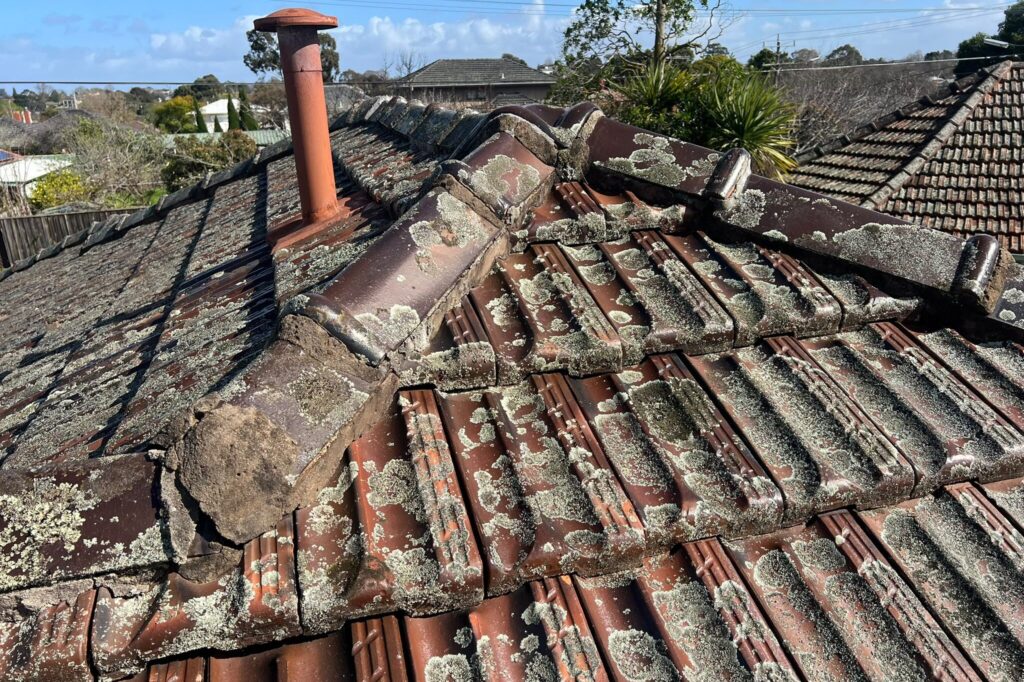
Over decades, weather and roof movement crack the bedding and pointing. Once the bedding breaks down, caps work loose and water gets through to the ceiling, the insulation and even electrical components in the roof space. As our crew member Ryan puts it: water finds a way.
Signs your ridges need work
- Cracks in the mortar along ridge and hip caps
- Ridge or hip caps that are loose, uneven or out of line
- Chunks of mortar or grit in the gutters
- Leaks or ceiling stains, especially in wind-driven rain
- A roof 30 years or older with its original ridge bedding
Read more in how to tell when your roof needs repointing.
Cracked or loose ridge capping?
Book a free inspection and get a fixed written quote.
Rebed, or repoint only?
| Condition | Usually needs | What it involves |
|---|---|---|
| Pointing cracked, bedding solid | Repoint | Flexible pointing applied over the existing bedding |
| Bedding crumbling or caps loose | Rebed and repoint | Caps lifted, old mortar removed, caps rebedded, then pointed |
| Several roof problems at once | Restoration | Ridges done alongside cleaning, tiles, valleys and coating |
Pointing over failed bedding is a shortcut that does not last. We tell you which your roof needs after an inspection.
How we rebed and repoint
- InspectWe check every ridge and hip, plus the tiles and valleys around them.
- Safety set-upOur own temporary safety rail and ladder guards go up before work starts.
- Remove the caps and old mortarRidge and hip caps are lifted and all failed bedding removed.
- RebedCaps are bedded on fresh mortar, aligned and set.
- RepointFinished with flexible pointing, which flexes with normal roof movement without cracking.
- Clean upOld mortar is removed from the roof and gutters.
The National Construction Code requires every ridge and hip tile to be fixed, and lists flexible pointing complying with AS 2050 as one of the permitted fixings.
Sources: NCC 2022 Housing Provisions Part 7.3: Roof tiles; HIA: AS 2050 Installation of roof tiles; Monier: Flexible pointing technical data sheet.
From the roof: a real job in East Melbourne
On a 40-year-old double-storey cement tile roof in East Melbourne, our crew carried out a full rebed and repoint along with valley iron replacement. Ryan, with 20 years in the trade, described the process simply: remove the ridge cappings, remove the old mortar, rebed, then finish with flexible pointing.
Read the full walkthrough in roof repair in East Melbourne.
What affects the cost
| Factor | Why it matters |
|---|---|
| Length of ridges and hips | Hip roofs have more capping than simple gable roofs. |
| Rebed or repoint | A full rebed takes longer than a repoint only. |
| Height and pitch | Double-storey and steep roofs need more safety set-up. |
| Broken caps | Damaged ridge caps replaced from our yards. |
Every quote is fixed and written after a free inspection.
Safety on every job
WorkSafe Victoria’s compliance code for housing construction puts edge protection such as guard railing ahead of harnesses and ladders when controlling the risk of falls from a roof. Our crews set up our own temporary safety rail, ladder guards and, where there are old skylights, safety nets before anyone works on the roof. Every crew member holds a working at heights qualification.
Sources: WorkSafe Victoria: Prevention of falls in housing construction.
Common questions
How do I know if my roof needs a rebed and repoint?
Look for cracked mortar along the ridge caps, loose or uneven caps, or chunks of mortar in the gutters. Leaks in wind-driven rain are another sign. An inspection confirms whether the bedding has failed or only the pointing.
How long does a rebed and repoint last?
Done correctly with the right materials, a rebed and repoint should last 15 to 20 years. Shortcuts such as pointing over failed bedding, or using the wrong products, shorten that considerably.
What is the difference between rebedding and repointing?
Rebedding replaces the mortar the ridge caps sit on. Repointing renews the flexible finishing layer over the bedding. If the bedding is solid, a repoint may be enough; if it is crumbling, the caps need rebedding first.
Why use flexible pointing?
Flexible pointing is designed to flex with normal roof movement without cracking, which is where old rigid pointing fails. It is also listed in the National Construction Code as a permitted fixing for ridge and hip tiles when it complies with AS 2050.
Is rebedding part of a roof restoration?
Yes. Where ridges need it, rebedding and repointing is included in our roof restoration alongside cleaning, tile replacement, valley replacement and coating.
Do you rebed terracotta and concrete roofs?
Yes, both. We match any broken ridge caps from our yards in terracotta or concrete, including older profiles.
Related services