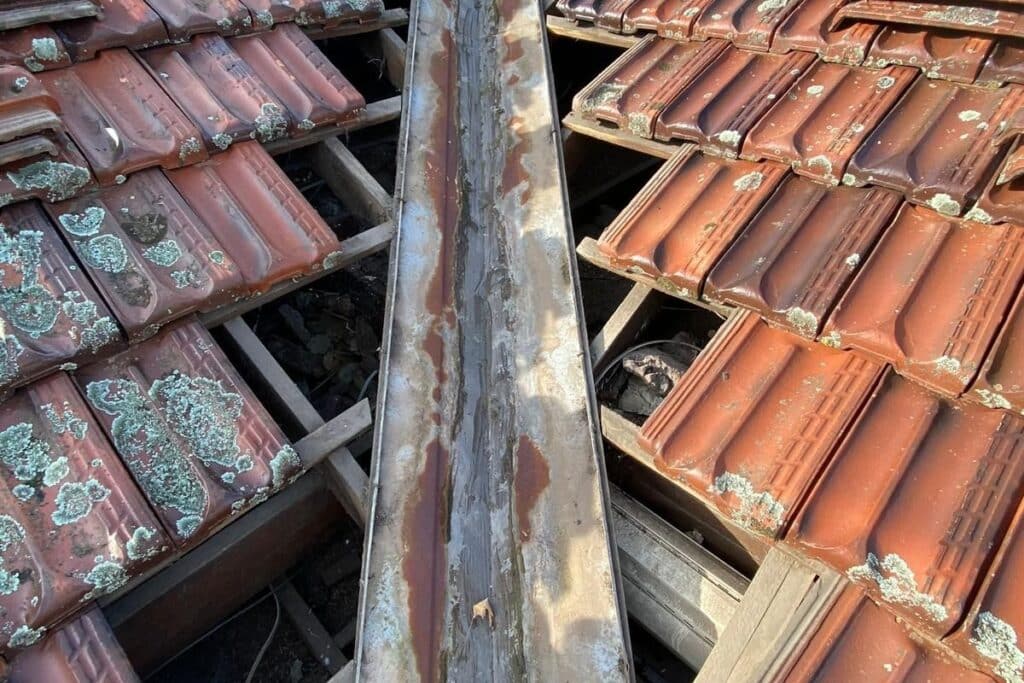
The valley is the channel where two roof slopes meet, and it carries more water than any other part of a tiled roof. When the valley iron rusts through or blocks with leaves, water goes straight into the roof cavity. Royce Roofing replaces failed valleys with new Zincalume and refixes the tiles either side, making the roof watertight again.
At a glance
- Rusted valleys are one of the most common causes of tiled roof leaks
- We replace them with new Zincalume valley iron
- Valley tiles refixed and cracked tiles replaced from our own yards
- Included in every roof restoration where needed
- Free inspection and fixed quote
What is a roof valley?
Wherever two roof planes meet in an internal corner, they form a valley. Water from both slopes runs into it, so a valley carries the combined run-off from two sections of roof down to the gutter. On a tiled roof, the valley is lined with a metal channel, the valley iron, and the tiles on each side are cut to follow the line of the valley and sit over the edges of the iron.
- Valley iron: the metal channel that carries the water
- Valley tiles: the cut tiles either side, which must be fixed to the roof
- Valley boards and battens: the timber supporting the iron
- Storm seal or foam filler: fitted where required to stop wind-driven rain getting under the tiles
Signs your valley needs attention
- Water stains on the ceiling near where two roof sections meet
- Rust visible along the valley line from the ground, or rust stains in the gutter below
- Leaves and debris building up in the valley and holding water
- Water overflowing the valley edges or the gutter at the bottom of the valley in heavy rain
- Leaks that appear only in heavy rain
- Cut tiles along the valley loose, cracked or slipping
- A roof more than 20 to 30 years old with its original valley irons
Why valleys fail
Rust
Older valleys are often galvanised steel. BlueScope no longer recommends galvanised steel for gutters and downpipes, recommending Zincalume or Colorbond steel instead, because galvanised steel corrodes under run-off from tiled roofs.
Leaves and debris
Gum leaves and debris dam the valley, hold water against the metal and push water sideways under the tiles.
Loose valley tiles
Cut tiles along the valley that are not properly fixed can slip, letting water past the edge of the iron.
Failed sealing
Old storm seal and mortar along the valley break down and let wind-driven rain in.
Rusty valleys or leaks in heavy rain?
Book a free inspection and get a fixed quote.
What a valley replacement involves
- InspectWe check the valley iron, the tiles either side and the sarking and battens underneath.
- Safety set-upOur own temporary safety rail goes up before work starts.
- Lift the tilesTiles along both sides of the valley are lifted and set aside.
- Remove the old valleyRusted valley iron and any damaged sarking or timber come out.
- Fit new ZincalumeNew valley iron goes in, with storm seal where required.
- Re-lay and fix the tilesTiles go back down and are fixed; the National Construction Code requires valley tiles to be fixed in every non-cyclonic wind class. Cracked ones are replaced from our yard.
- Repoint where neededWhere the valley meets ridges or hips, bedding and flexible pointing are made good.
- Clean upWe take all old material away and clear the gutter at the bottom of the valley.
Clean, reseal or replace?
| Valley condition | Usually needs |
|---|---|
| Sound iron, blocked with leaves | Clean the valley and gutters |
| Sound iron, loose valley tiles or failed seal | Refix tiles and reseal |
| Surface rust, metal still solid | Monitor closely and plan replacement |
| Rusted through, holes or leaks | Full valley replacement |
Patching a rusted-through valley only delays the problem. Once the metal has failed, replacement is the proper fix.
What affects the cost of valley repairs
| Factor | Why it matters |
|---|---|
| Number and length of valleys | Hip roofs with several valleys take longer than one short valley. |
| Height and pitch | Double-storey and steep roofs need more safety set-up. |
| Tile condition along the valley | Brittle or cracked valley tiles need replacing as the valley is relaid. |
| Damage underneath | Water-damaged battens or sarking found when the tiles are lifted. |
| Tile profile | Discontinued profiles may need reclaimed stock from our yards. |
Keeping valleys clear
Monier recommends cleaning valleys at least once a year, and more often near trees. If your home is under gum trees, regular valley and gutter cleaning is the cheapest way to extend the life of the valley iron. When valleys are replaced as part of a roof restoration, they are done once alongside cleaning, repointing and recoating.
Once valley iron has rusted through, every heavy rain sends water into the roof space. Early replacement avoids damage to ceilings, insulation and timber.
Sources: Monier: Roof cleaning and maintenance.
Safety on every job
WorkSafe Victoria’s compliance code for housing construction puts edge protection such as guard railing ahead of harnesses and ladders when controlling the risk of falls from a roof. Our crews set up our own temporary safety rail, ladder guards and, where there are old skylights, safety nets before anyone works on the roof. Every crew member holds a working at heights qualification.
Sources: WorkSafe Victoria: Prevention of falls in housing construction.
Common questions
How do I know if my roof valleys are rusted?
From the ground you may see orange-brown rust along the line where two roof slopes meet, or rust stains in the gutter below. Inside, look for water stains on the ceiling near those junctions. A roof inspection confirms it and checks the sarking underneath.
What material do you use for new valleys?
We replace rusted valley irons with new Zincalume. BlueScope recommends Zincalume or Colorbond steel over galvanised for roof drainage, because galvanised steel corrodes under run-off from tiled roofs. Storm seal is fitted where required to stop wind-driven rain getting under the valley tiles.
Can valleys be repaired instead of replaced?
Once valley iron has rusted through, replacement is the proper fix. Patching or sealing a rusted valley only delays the problem. If the valley is sound but blocked with debris, or the tiles beside it are loose, cleaning and refixing may be all that is needed.
How often should roof valleys be cleaned?
Monier recommends cleaning valleys at least once a year, and more often if trees overhang the roof. Gum leaves are a common culprit in Melbourne. Keeping valleys clear stops water backing up under the tiles and slows rust on the valley iron.
Why does my roof only leak at the valley in heavy rain?
In heavy rain the valley carries the run-off from two roof planes at once. If it is partly blocked, too narrow for the flow, or the tiles beside it have slipped, water overflows its edges and runs under the tiles. Light rain drains normally, so the leak only shows in storms.
Is valley replacement part of a roof restoration?
Yes. Where valleys need replacing, it is included in our roof restoration service alongside pressure cleaning, tile replacement, rebedding and repointing, and recoating, so the whole roof is brought back to a watertight condition in one job.
Related services