

On a tiled roof, the most common places to leak are the valleys, the ridge and hip capping, and the flashings around chimneys, walls, skylights and vents. Cracked or slipped tiles and blocked gutters are close behind. Valleys top the list because they carry the most water on the roof, and galvanised valley iron rusts from the inside out where leaves sit in it.
The short answer
- Valleys: rust and blockages, where two roof slopes meet
- Ridge and hip capping: cracked pointing and crumbling bedding
- Flashings: chimneys, walls, skylights, vents and solar mounts
- Cracked or slipped tiles: storms, hail and foot traffic
- Gutters: blocked gutters back water up under the bottom row of tiles
Where tiled roofs leak, and why
| Where | Why it leaks | Fix |
|---|---|---|
| Valleys | They carry the most water; leaves sit in them; galvanised iron rusts | Valley replacement |
| Ridge and hip capping | Pointing cracks and bedding crumbles, letting wind-driven rain in | Rebed and repoint |
| Flashings and penetrations | Flashings lift, corrode or are disturbed by other trades | Reseal or replace the flashing |
| Cracked or slipped tiles | Hail, branches, foot traffic and age | Replace the tile |
| Gutters | Blockages force water back under the tiles and into the eaves | Clear the gutters |
| Torn sarking | Small faults above become leaks below when the sarking fails | Repair during tile work |
Valleys
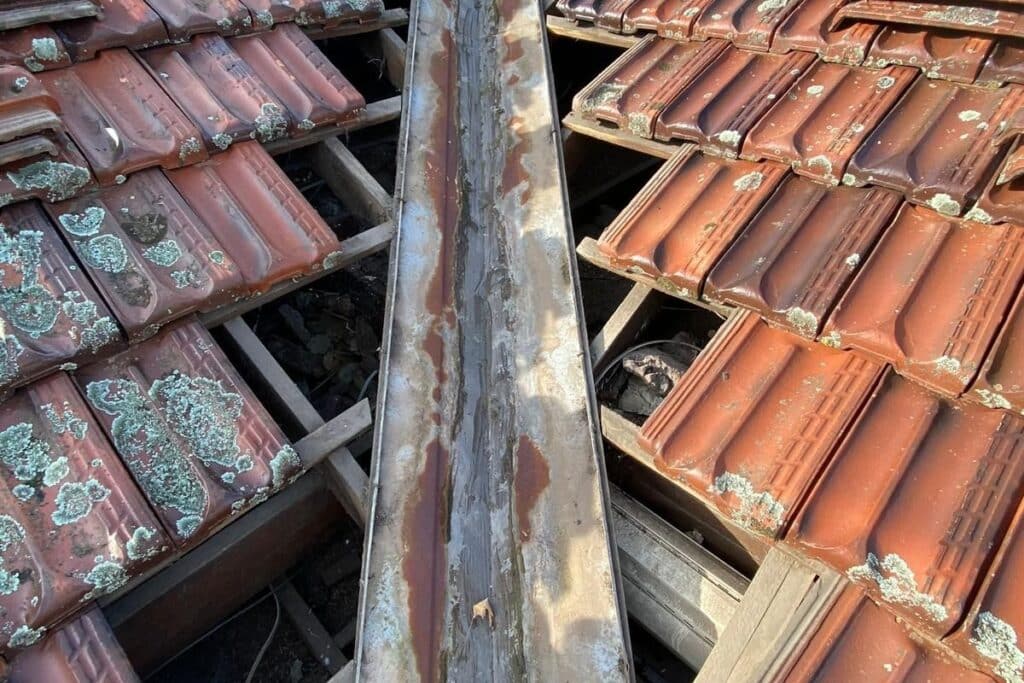
Valleys are the metal channels where two roof slopes meet. Every drop of rain on both slopes runs down them, along with leaves and grit. Debris holds water against the metal and galvanised valley iron eventually rusts through. BlueScope does not recommend galvanised steel for gutters for the same reason, and we replace rusted valleys with Zincalume or Colorbond. Monier recommends cleaning valleys at least yearly.
Sources: BlueScope: Steel for gutters and downpipes; Monier: Roof cleaning and maintenance.
Got a leak you cannot find?
We trace it in the roof space and on the roof, then fix the cause.
Ridge and hip capping
The curved caps along the ridges and hips sit on sand and cement bedding sealed with pointing. As the pointing cracks and the bedding breaks down, wind-driven rain gets in under the caps. These leaks often show only in storms, as a stain near the line of a ridge or hip. Mortar pieces in the gutters are an early warning.
Flashings and penetrations
- Where the roof meets a wall or chimney
- Around skylights and roof windows
- Around vents, flues and exhaust pipes
- Around solar panel mounts, antennas and air-conditioning units
- Where an extension roof joins the original house
Flashings move, corrode and get disturbed by other trades. Sealant has a place at flashing edges, but a lifted or rusted flashing needs refixing or replacing. See our guide to roof sealants.
Cracked and slipped tiles
Hail, falling branches and people walking on the roof crack tiles; strong wind and old fixings let them slip out of line. Melbourne’s 19 January 2020 hailstorm dropped stones up to 5.5 centimetres across the south-east suburbs, and storms like it are why a sound roof can suddenly leak. Our yards hold over 200 tile types to match replacements.
Sources: AIDR: Hailstorms and heavy rainfall, Victoria, January 2020.
Finding your leak
The stain on your ceiling is rarely directly under the fault: water runs along battens, sarking and joists first. A leak that shows only in wind-driven rain points to capping or flashings; a drip in any heavy rain points to valleys, tiles or gutters. See what to do when your roof leaks, or let us trace it with our leak repair service.
WorkSafe Victoria’s compliance code for housing construction puts edge protection such as guard railing ahead of harnesses and ladders when controlling the risk of falls from a roof. Our crews set up our own temporary safety rail, ladder guards and, where there are old skylights, safety nets before anyone works on the roof. Every crew member holds a working at heights qualification.
Common questions
Where is the most common place for a roof to leak?
On tiled roofs, valleys are the most common, followed by ridge and hip capping and the flashings around chimneys, walls, skylights and vents.
Why do roof valleys leak?
They carry the most water on the roof and collect leaves. Debris holds water against the metal and galvanised valley iron rusts through.
Why does my roof only leak in heavy wind and rain?
Wind-driven rain gets under failing ridge capping and lifted flashings. These leaks often show as stains near ridge lines or walls.
Can blocked gutters cause a roof leak?
Yes. Water backs up under the bottom row of tiles and into the eaves, and can stain ceilings near outside walls.
Can a cracked tile cause a leak?
Yes. Water gets onto the sarking and, if the sarking is torn or missing, into the roof space and ceiling.
How do I find where my roof is leaking?
Check the roof space with a torch for water marks on timbers and sarking, then the roof from the ground. A roofer can trace it on the roof.
Related
Sources: BlueScope: Steel for gutters and downpipes; Monier: Roof cleaning and maintenance; AIDR: Hailstorms and heavy rainfall, Victoria, January 2020.

Comments are closed